
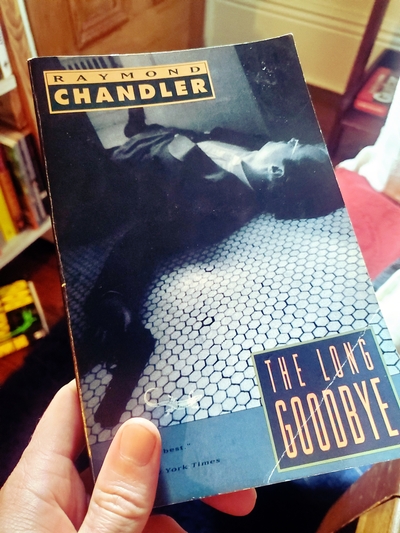
All of the Marlowe stories and Chandler’s entire linguistic style reduces to this one paragraph.
I got up and walked around the room. It was going to be a hot day. It already was hot. I turned the blinds on one of the windows to keep the sun out. Then I gave it to her straight. 1
In terms of perspective, he is maniacally focused on concrete details, but presents them as simply as possible.
Next morning the bell rang as I was wiping the talcum off an earlobe. When I got to the door and opened up I looked into a pair of violet-blue eyes. She was in brown linen this time, with a pimento-colored scarf, and no earrings or hat. She looked a little pale, but not as though anyone had been throwing her downstairs. She gave me a hesitant little smile.
In terms of grammar, he is not particularly fussy about commas, and punctuation in general.
I stopped and looked at her and she smiled at me.
Basically, he uses commas mostly as they “ought” to be used: as demarcation for secondary and subordinate clauses and clarification. But he does also use them for style, cadence, or rhythm.
I looked at the first piece, the one not crumpled. There was a short typewritten paragraph on it, no more.
And often you find a combination of both, direct, functional punctuation, with the occasional bit of staccato truncation that creates uniquely stumblebum Chandlerian style.
She reached into her bag again and came up with a couple of pieces of yellow paper. They looked like second sheets, folded, and one of them looked crumpled. She smoothed them out and handed them to me.
A modern writer would probably lean into the gerunds and write the latter paragraph as.
She reached into her bag again, coming up with a couple of pieces of yellow paper. They looked like second sheets, folded, one of them looking crumpled. She smoothed them out, handing them to me.
Personally, I dislike the gerund thing. It blurs the image and makes the writing feel sloppy. It isn’t particularly ugly, and I’m sure people will argue aesthetics, but I retain the right to think it’s a bad aesthetic choice.
Ego-Death
The main feature of Chandler’s style is that it is utterly unpretentious and egoless and yet full of personality. The power of simplicity and restraint means that the character cuts through because there is no fancy/lazy/sloppy junk to get in the way. Sentences become awkward and ungainly when you give in to the temptations of grammatical flair. Basically, this style is the simplest possible arrangement of the words which conveys the information in the most sensible possible way: Subject > Verb > Object. You can play with a prepositional gerund phrase to lead in, but the core is still SVO. These sentences all work perfectly well:
Before I stepped out into the rain I pulled on my coat.
Before I stepped out into the rain, I pulled on my coat.
Pulling on my coat I stepped out into the rain.
Pulling on my coat, I stepped out into the rain.
I pulled on my coat before stepping out into the rain.
Before stepping out into the rain I pulled on my coat.
Before stepping out into the rain, I pulled on my coat.
I stepped out into the rain after pulling on my coat.
But none of them is as evocative as:
I pulled on my coat and stepped out into the rain.
Chandler is a particularly minimalist proponent of this very simple approach but more indulgent writers like David Foster Wallace do essentially the same thing.
There was a yelp and a crash and a tinkle; the bartender lay sprawled over the bar with his head in a palm-tree pot, his legs in white cotton pants waving, beer on the floor. 2
This can be Chandler-ised into:
There was a yelp and a crash and a tinkle. The bartender lay sprawled over the bar with his head in a palm-tree pot, his legs in white cotton pants waving, beer on the floor.
Only at the end does it still get messy, because he’s trying to squeeze in the detail about the color and texture of the pants. This is easily fixed by re-structuring the sentence into basic SVO format.
His white cotton pants flapped around his waving legs. There was beer on the floor.
So that in sum we get:
There was a yelp and a crash and a tinkle. The bartender lay sprawled over the bar with his head in a palm-tree pot. His white cotton pants flapped around his waving legs. There was beer on the floor.
I am not saying that this is what he should have done. It’s his book, so he can do whatever he wants. He also killed himself, so there’s nothing he can do about it now anyway. What I am saying is that I find the simpler grammatical formulation more emotionally evocative. This is counter-intuitive for me and many other people because those of us who have learned to read and write at a high level have done so by reading books written by people who were enthralled by the myth of genius.
Ego-Bullshit
There is a lot of ego-bullshit wrapped up in being a literary talent and writers who believe that they have or ought to have this talent write in a way that makes their genius clear. They introduce complex grammatical crenellations to show off their prowess and employ a more flowery and elaborate vocabulary. When done well it’s truly wonderful, but when done even slightly less well it occludes rather than illuminates.
I have been sidetracked by this belief for decades and have worried and worried about my writing style. I have gone through phases in which my writing has looked like the outside of a gothic church, all full of fancy fiddly bits filled in order to assuage my terror of blank space and anything left unsaid.

I believed that good writing was artful writing and that artful writing meant complex writing and complex writing meant busy writing. I am finally seeing that this could not be less true. The syllogism is reversible, but the essential point of note is the conditional “can be”.
Complex writing can be beautiful.
Beautiful writing can be complex.
A Number of Acts of Literary Desecration
Complex writing is not by definition beautiful, but when done well it can be lovely. Salman Rushdie, for example, writes in a breathless, looping, and lyrical style that is beautiful, if somewhat exhausting.
Pandit Gopinath Razdan, an exceedingly thin man with a deep furrow between his eyebrows, the reddened gums of an addict of paan and the air of one who expected to find much to be dissatisfied with wherever he went, arrived at Boonyi’s door wearing narrow gold-rimmed spectacles and a pinched expression, carrying an attaché case full of Sanskrit texts and a letter from the education authorities. (p. 102)3
But he also knows when to tighten up.
Terror was killing livestock, like a plague.
Or:
These dream women were the ones he wanted. Any one of them was worth ten Boonyis.
The longer paragraph above can also easily be split up into a basic SVO structure, and much more easily than it might look at first.
Pandit Gopinath Razdan was an exceedingly thin man with a deep furrow between his eyebrows.
He had the reddened gums of an addict of paan and the air of one who expected to find much to be dissatisfied with wherever he went.
He arrived at Boonyi’s door wearing narrow gold-rimmed spectacles and a pinched expression and carried an attaché case full of Sanskrit texts and a letter from the education authorities.
Which reads as:
Pandit Gopinath Razdan was an exceedingly thin man with a deep furrow between his eyebrows. He had the reddened gums of an addict of paan and the air of one who expected to find much to be dissatisfied with wherever he went. He arrived at Boonyi’s door wearing narrow gold-rimmed spectacles and a pinched expression and carried an attaché case full of Sanskrit texts and a letter from the education authorities.
Again, it’s his book and his life and I don’t presume to correct one of the genuine modern masters of literature. But I also kind of do. As I compare the two paragraphs I find that the looping quality of the first creates a scattering effect that detracts from the images being evoked.
Things get frazzled because he interjects descriptive details into a parenthetical clause that splits the sentence and puts a huge distance between Subject and Predicate and then adds a bunch of extra information afterwards.
Pandit Gopinath Razdan an exceedingly thin man with a deep furrow between his eyebrows, the reddened gums of an addict of paan and the air of one who expected to find much to be dissatisfied with wherever he went, arrived at Boonyi’s door wearing narrow gold-rimmed spectacles and a pinched expression, carrying an attaché case full of Sanskrit texts and a letter from the education authorities.
The actual action is:
Pandit Gopinath Razdan arrived at Boonyi’s door.
The descriptive details are also presented scattershot across the paragraph in a way that exacerbates the issue. He splits the description of the face, glasses, and expression across the predicate which gives a very disjointed feeling.
Original:
Pandit Gopinath Razdan, an exceedingly thin man with a deep furrow between his eyebrows, the reddened gums of an addict of paan and the air of one who expected to find much to be dissatisfied with wherever he went, arrived at Boonyi’s door wearing narrow gold-rimmed spectacles and a pinched expression, carrying an attaché case full of Sanskrit texts and a letter from the education authorities.
Re-arranged both grammatically and keeping relevant details together:
Pandit Gopinath Razdan had the reddened gums of an addict of paan. He was exceedingly thin and had a deep furrow between his eyebrows. He wore narrow gold-rimmed spectacles and a pinched expression which gave him the air of one who expected to find much to be dissatisfied with wherever he went. He arrived at Boonyi’s door carrying an attaché case full of Sanskit texts and a letter from the education authorities.
As a reader, this presentation makes the image of Pandit the person much easier to visualise. I also realise that what I have done is utter blasphemy to some people.
Pragmatically Lowbrow
We are now squarely in the realm of aesthetics vs. pragmatism and I’m surprised to find myself coming down on the pragmatic side. This may simply be because I am 40+ and my linguistic brain is less flexible than it used to be. So it may be that that which is most pleasing to me now is simply that which I can parse most easily. But when I reflect on it, my favourite novels from any stage of life have never been the “literary” ones. They were the ones that communicated the story’s events and the character’s inner experience clearly and succinctly and left me room to fill in the blanks with my own imagination.
This from Orson Scott Card:
After such a thing nothing could be said. Alai reached his bed and turned around to see Ender. Their eyes held only for a moment, locked in understanding. Then Ender left. (p. 75)4
This from J.R.R. Tolkien:
Suddenly there was a great shout, and down from the Dike came those who had been driven back into the Deep. There came Gamling the Old, and Eomer son of Eomund, and beside them walked Gimli the dwarf. He had no helm, and about his head was a linen band stained with blood; but his voice was loud and strong. (p. 530)5
These two randomly-selected passages are not in any way fancy but even completely out of context their emotion comes through unimpeded. They are clearly written by different people, in different styles and with different moods, but they both use their language relatively simply and mostly stay out of the reader’s way.
I very much dislike the way Stephen King puts words together but I do agree with him that the elitism of the writing world does more to turn people off reading than encourage them to engage with great literature.
Details, Details
The last point that I don’t want to miss is the important feature that obtains regardless of the writer’s uses and abuses of grammar: description. In terms of the kinds of details described, Rushdie’s is almost exactly the same as Chandler’s would have been, though Chandler spends a lot more time on clothes and general appearance.
He was middle aged, rather plump, dressed as if he didn’t give any thought to it, but well shaved and with thin hair smoothed back carefully over a head that was wide between the ears. He wore a flashy double-breasted vest, the sort of thing you hardly ever see in California except perhaps on a visiting Bostonian. His glasses were rimeless and he was patting a shabby old dog of a briefcase… (pp. 90-91) 6
References
The Long Goodbye, Vintage Crime, 1992↩︎
The Long Goodbye, Vintage Crime, 1992↩︎
The Broom of the System, Penguin, 2004↩︎
Shalimar the Clown, Vintage Canada, 2006↩︎
Ender’s Game, TOR, 1986↩︎
The Two Towers, Harper Collins, 1997↩︎