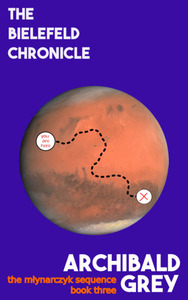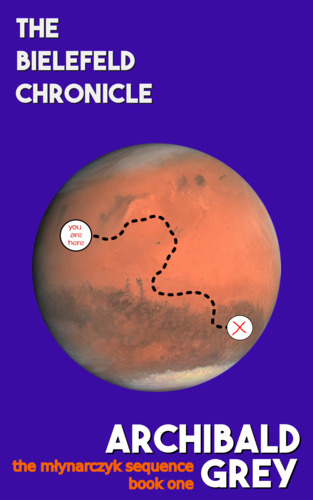
Jacob Młnarczyk is an aimless drifter, who quits his dead-end supermarket job and embarks on a journey to Bielefeld, a city that doesn’t exist.
Inspired by the psychedelic and psychological science fiction of the 1960’s and 1970’s, the Bielefeld Chronicle is a surreal encounter with life, death, love, and betrayal.
Combines elements of magical realism and science fiction to create a fantastical, allegorical journey into the mind.
Purchase Options





Excerpt
Gravity doubled. A breeze tried again, and again, failed. Nothing moved. Heat. A drop of sweat began to gather on the tip of Jacob’s nose. Humidity. Over the tall sound barriers up and down the tracks, tree branches drooped, listless leaves looking exhausted. Sweat. Ancient, derelict buildings ran alongside the tracks and wobbled visibly in the heat-swelled air. Fire. The corrugated steel awning under which he sat radiated an even, unceasing heat into the obsidian black shadow it cast. Boiling. The golden sunlight wrapped the world in a yellow tinfoil blanket and put it in the oven. Sweltering. Jacob could feel his skin going soggy.
A memory. The fifth floor of a cheap apartment building in Florida. In the distance, the thin finger of a steel-grey tornado reaching down to the ground out of a sky decked with clouds.
The drop fell from his nose and clatched on the concrete between his feet. The spot it left on his nose itched with a prickly heat, and Jacob rubbed it with the back of his hand and then wiped the sweat from his forehead.
The voice was gentle, and yet deep and strong, “Are you waiting for a particular train, sir?”
Jacob looked around, startled, he could see nothing in the shadows around him, “Actually, yes.”
The voice sounded like it came from a smiling mouth, “And?”
Jacob didn’t know where he should look, “I was told to wait at this stop.”
“And?”
“And so, here I am.”
“Good.”
Nothing changed in the world in front of him. The green of the trees remained loud, the blue of the sky continued to burn. And yet this new moment was different from the one before, brighter somehow. He looked to the ground and saw that he was sitting in a column of shadow surrounded by brightly lit concrete. He looked up. The awning too was lit from underneath. Jacob looked behind him and saw a train-shaped mass of blinding light interrupted only by the matte silhouette of a gigantic man. The silhouette spoke, “You may board now, sir.”
Jacob stood up slowly and walked over to the train made of light. It was cool to the touch. He didn’t want to know if this was a good idea or not, so he didn’t ask. What he did ask was, “How?”
“How what?”
“How do I get on?”
“I thought it should be obvious.”
“Maybe so, but not for me.”
The silhouette chuckled and put his heavy hand on Jacob’s shoulder, gently. The world twisted itself around a point in the far distance, and when it had untwisted again, Jacob found himself sitting on a seat in a train with no walls. He looked up and saw the clear blue sky and the fearfully bright sun, and felt cool and comfortable.
Without a shudder, shake, creak, or groan, the train pulled out of the station. Jacob almost didn’t notice, except for the curious feeling that the world around him had started to move backwards while he remained motionless. Slow acceleration gave way to high velocity, so fast that the trees and bushes and dirt that lined the tracks blended into a mushy wirr-warr of brown and green and grey.
The shadow conductor walked past, seeming to ignore Jacob completely. “Excuse me,” Jacob asked, feeling like a child in school, “Where are we going?”
The black shape paused and tipped his head lightly to one side, “You really don’t know?”
“How could I know when no one has told me anything?”
Again the voice smiled, “Good question.”
The train continued silently on. The swimmy green world lulled at him, and Jacob stared hypnotised and thoughtless out the window. Time passed without drawing particular attention to itself. The world was blue and green and brown, simply and intelligibly, and there was nothing at all to worry about.
And then the green wall broke, and tumbled out into a wide vista with clear shapes and delineated forms; a fallow field of wine-red earth, rolling gently uphill towards the sky. A tree stood at the top of the rise, gigantic, powerful, with red leaves although it was high-summer. Next to the tree was a large, old, white-painted Farmhouse, whose walls were criss-crossed by large beams of red-brown wood. It was a stately tableau of perfect natural beauty, which rolled by in unearthly slow-motion parallax.
And then, a tunnel, sudden darkness.
With it came a strange, two-toned whistle, simultaneously harmonic and inharmonic, which forced its way into Jacob’s ears. He swam in the blackness, and he felt his stomach turn, as if he were being turned upside down, very slowly. He screwed his eyes shut and clung to the armrests and tried not to throw up. The train began to vibrate and anxiety began to creep in rings around Jacob’s torso, his thighs, and down to his ankles. The anxiety of simple existence. Stasis, motionlessness, frozen in living death, paralyzed by the removal of time. Pure being itself in its terrible, crushing, unchanging, immovably timeless identity. In the crushing darkness, images came to his mind, of other darknesses, of horrifying machines, of smiling faces, imperious faces, blank faces, spiderwebs of silk, and glass – a fractal litany of not-even-yesterdays, already repressed and forgotten. A girl with a ponytail turned herself away from him and faded away into the peach-pink of sunlight seen through closed eyelids.
Jacob opened his eyes. The train stood at a platform in a grand station vaulted by a tall arch of rectangles of flat glass supported by enormous iron girders. Soft evening light filtered down into the dusty twilight.
An old man leaned on an old walking stick in front of an empty timetable display case. He waved to Jacob. Jacob looked around, confused, but of course, there was nobody else on the train. The old man shook his head in a disappointed kind of way. To nobody in particular Jacob asked, “How do I get out of this thing?”
And then he was standing outside, the thin wind playing through his thin hair.
The old man came over, every other step accented by the soft click of his cane, a sound that drifted off, echoless in the enclosed expanse. Without a glance at Jacob the old man said, “Come on.”
More Books